| The CAD revolution in building design has already passed. Designers have now moved on to BIM -
virtual Building Information Modelling - based on digital information exchange. |
| |
| With so much design information available in digital form, and its capacity to change the way the
industry works, the benefits of BIM to Cost Engineers and Managers are impossible to ignore.
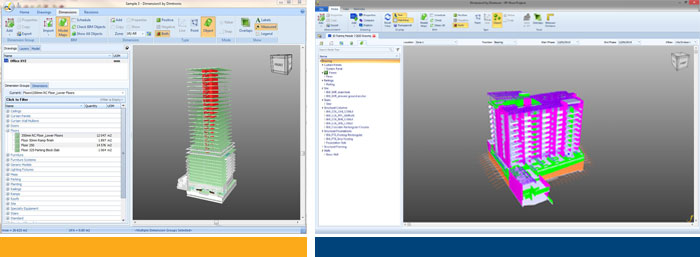
dimensionX supports BIM by using digital design data to accurately estimate quantities and costs,
within a live electronic environment. |
| |
| The next logical step – Integrated Project Delivery (IPD) via an integrated BIM platform – will enable
quantity surveyors using dimensionX with WinQS to play a central role in a new industry paradigm,
characterised by better industry productivity and improved building design, efficiency, performance
and whole of life cost. |
| |
| The introduction of 2D CAD into the construction industry saw immediate productivity benefits that
are now well established. With the move to 3D, CAD developed beyond being a drafting tool to
become a medium for creating and optimising designs. With advances in technology, BIM is now
becoming the new platform for an integrated approach to building design, procurement and
ownership. |
| |
| The concept is simple: have one, and only one, centrally accessible, database driven, virtual
representation of all aspects of a building. The central database enables the design team, contractor,
subcontractors, facility managers and owners to track all changes within the single model and gain
real-time access to volumes of data far more effectively than current methodologies allow. The
result? Real gains in industry productivity, building life cycle cost and sustainability. |
| |
| The concept is now becoming a reality. In the past, limitations on software capability and file
interoperability have been a constraining factor – but this is rapidly changing. Already, design teams
routinely collaborate on shared software platforms, contributing towards an irresistible industry
movement to BIM driven by a common desire to implement its benefits. Make no mistake – BIM is
here to stay. |
| |
| The power of BIM lies in its expansive range of applications for users. At its basic level, BIM
represents an evolution from traditional 2D design to object based 3D modelling. However, because
the model is built around a parametric database, the more data that users add to it, the wider the
range of analyses such as building performance, schedules and costs that can be leveraged from it. |
| |
| Currently, 3D design modelling is the most popular use of BIM in construction, with architects
leading the way. However, the situation is rapidly changing as advances in software technology allow
other users to find selective ways to model elements in BIM, and interrogate the model database to
suit their needs. These differing types of usage of BIM have given rise to a series of categorizations
which provide convenient labels for developmental stages, but will become largely redundant as
technology improves and an increasingly holistic approach to BIM becomes established. |
| |
|
| |
| 3D BIM refers to a design model made up of intelligent parametric objects, as distinct from 3D
graphics which simply refers to geometric dimensions of points or lines in terms of x, y and z axes. |
| |
| 4D is the commonly accepted term for combining time sequencing into the 3D model. The model
may be enhanced with logistics objects such as hoists or cranes and construction activities can be
modelled to optimise scheduling. |
| |
| 5D is used to describe the process and applications of costing in BIM. |
| |
| 6D is emerging as a BIM term in which the model may incorporate energy modelling tools and
facilitate sustainability analysis. |
| |
| nD modelling, still largely at conceptual stage, develops the application of BIM to incorporate any
number of variables into a holistic model, which would enable users to portray and visually project
the building design over its complete lifecycle. Thus, in addition to design information, the model
database may also contain information about the building‟s construction, management, operations
and maintenance to expand the modelling capabilities into such areas as accessibility, crime
deterrence, legislative compliance, and the like. |
| |
|
| |
| Whatever the label, the underlying philosophy remains the same; that BIM provides a means to
achieve a knowledge based, integrated approach to building design, procurement and ownership.
The ability to combine and share data which was traditionally spread across multiple disciplines
engenders greater collaboration which in turn produces better design solutions. |
| |
| The leveraging effect of collaboration is embodied in an approach to building procurement called
Integrated Project Delivery which is defined by the American Institute of Architects as follows: |
| |
| “IPD is a project delivery method that integrates people, systems, business structures and practices
into a process that collaboratively harnesses the talents and insights of all participants to optimize
project results, increase value to the owner, reduce waste, and maximize efficiency through all
phases of design, fabrication, and construction.” |
| |
| So where does this leave Quantity Surveyors and Estimators? Experience to date would suggest that
the custodians of the Fifth Dimension have been slow to come to the digital party. Designers have
been exchanging data digitally for years, yet the bulk of quantities measurement remains paper-
based. As the design professions continue to collaboratively develop their CAD and BIM capabilities
to ever higher levels of sophistication, this gap will continue to widen. |
| |
| What‟s been missing is an interoperable software tool which allows the seamless transfer of digital
information between designers and estimators. Lack of such a tool in the past has meant that CAD
automation of the design process and the development of collaborative BIM processes has yet to be
harnessed and exploited in the Fifth Dimension. |
| |
|
| |
| Finally the software exists to short-cut the traditional approach and break down industry barriers..
Based on fast and extremely simple extraction of cost geometry and building dimensions from CAD
files by non-CAD users, dimensionX together with WinQS allows users to provide instant itemised
budgets or valuations for proposed buildings at any stage of the design process and, crucially, allow
the user to easily identify changes and re-calculate when revisions are made. |
| |
| Rather than working in isolation to produce their quantities and costings for the project, by
participating in the data interchange Cost Managers effectively get to play on the team instead of
watching from the sidelines. Automated quantities generation provides a faster, more accurate tool
to analyse data and provide better advice. This enables real-time options modelling and facilitates
scenario testing to explore ways to improve building design, efficiency, performance and cost. Using
dimensionX enables clients, designers and cost planners to collaborate and explore opportunities
with the aim of eliminating risk, reducing costs and producing better buildings. |
| |
| dimensionX supports and promotes cost management as an integral part of the BIM process
because ultimately, professional advice will always be needed to analyse and interpret cost data in
preference to the raw output from any software program, no matter how sophisticated. The
sequential nature of design will always mean that early models will lack detail and definition. These
“design intent” models provide opportunities for collaboration and analysis, testing and validation
but are insufficient for construction and cannot form the basis of a comprehensive costing exercise.
Hence, as with traditional costing procedures, the skill and experience of the estimator will be
required to fill in the gaps. |
| |
| BIM is also not the death of 2D drawings, which will remain a universal language of construction. |
| |
| In order to deal with the many types of design media currently in use, dimensionX® has universal
application ranging from hand-drawn sketches, through PDFs and CAD files, up to full 3D BIM
capability. A bi-directional graphical link to scanned images or standard industry drawing formats
(PDF, DWG, DXF, and many others) captures dimensions and quantities using intelligent
measurement tools. No CAD software or experience is required. All measurements can be live-linked
into WinQS |
| |
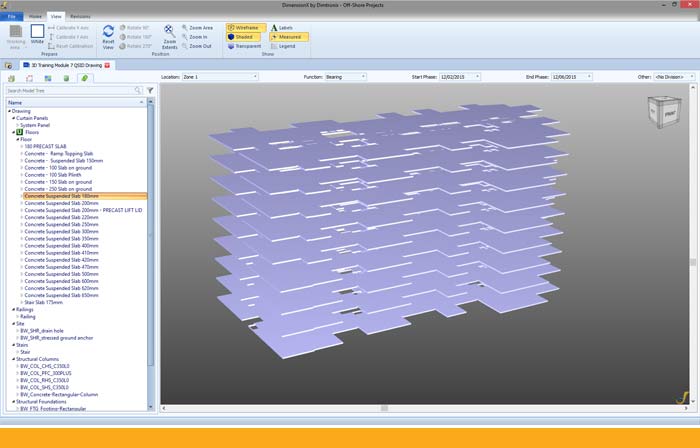
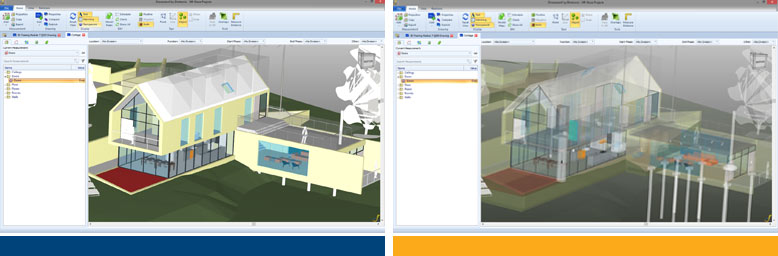
| The BIM capability arises from the capacity to read parametric design models to automatically
extract object properties and their associated quantities. Rather than drafting plans and elevations
using lines, 3-D virtual models recognise objects (walls, doors, windows, etc) and their inter-
relationship. The properties (parameters) of each object are held in a database which can contain
highly detailed information, and the parametric coding of the objects within the database is read by
dimensionX to automatically generate the quantities. |
| |
| Whichever file format is used, having live links from drawing files means that changes to dimensions
are automatically updated, and enables the software to identify drawing revisions and update
quantities. The automation of the process can dramatically improve productivity with users
anecdotally reporting that work that would typically take days to complete can now be done in
hours. |
| |
| Clearly, the 21st Century is already seeing a paradigm shift in the way that buildings are designed,
built and operated. Advancements in software capability and interoperability are giving greater
traction to BIM and transforming how its users approach their work. As BIM continues to gain
ground, its impact will become even more profound and will redefine the way the industry works.
dimensionX makes traditional inefficiencies become a thing of the past, and many processes
obsolete. Its success is being driven by companies and individuals who see its potential and devote
their energies to being at the forefront of their industry and the best at what they do. |
| |